How to Find the Right Scale for Any Song (Bollywood & Western) – The Ultimate Guide
Anil Thakor
Founder of Sangeet Easy

How to Find the Right Scale for Any Song: A Guide for Indian Musicians
Every guitarist has been there. You're at a party, someone shouts "Yaar, play Kesariya!", and you freeze. You know the chords, but you can't find the starting note, and your solo sounds like a disaster.
Finding the scale (or key) of a song is the superpower that unlocks everything: perfect solos, accurate chords, and the ability to transpose (change pitch) to suit your singer's voice.
For Indian musicians, this can be tricky. Bollywood songs often blend Western scales with Indian Classical Ragas. A song might feel like C Major but use a Komal Ni (flat 7th) because it's based on Raga Khamaj.
In this guide, we'll show you how to find the scale of any track—whether it's a Bollywood classic or a modern pop hit—using three methods, including the fastest, most accurate tool: Sangeet Easy.
Method 1: The "Desi" Ear Training Method (Humming the 'Sa')
This is the traditional way. It takes practice but is essential for your musical growth.
- Listen to the Song: Play the track and close your eyes.
- Find the "Home" Note: Try to hum a single note that feels like the "resting point" of the song. In Indian classical music, this is your Sa (Shadaj).
- Match it on Your Instrument: Find that note on your guitar or keyboard.
- Example: If the note is 'G', your song is likely in G Major or G Minor.
- Major or Minor?:
- Play a Major chord (G Major). Does it sound happy/bright like the song?
- Play a Minor chord (G Minor). Does it sound sad/serious?
- Bollywood Tip: Many sad or romantic songs (like "Tum Hi Ho") use Minor scales (often Harmonic Minor), while upbeat tracks (like "Gallan Goodiyaan") are usually Major.
Method 2: The Chord Clue
Look at the chords! The first and last chords of a song are huge clues.
- If a song starts and ends on Am (A Minor), 90% of the time, the song is in the Key of A Minor.
- The Relative Minor Trick: Remember that every Major key has a "relative minor" cousin.
- C Major ↔ A Minor
- G Major ↔ E Minor
- Why this matters: A Bollywood song might use chords from G Major but focus heavily on E Minor, giving it a "sad but hopeful" vibe common in A.R. Rahman compositions.
Method 3: The Sangeet Easy Way (100% Accurate & Instant)
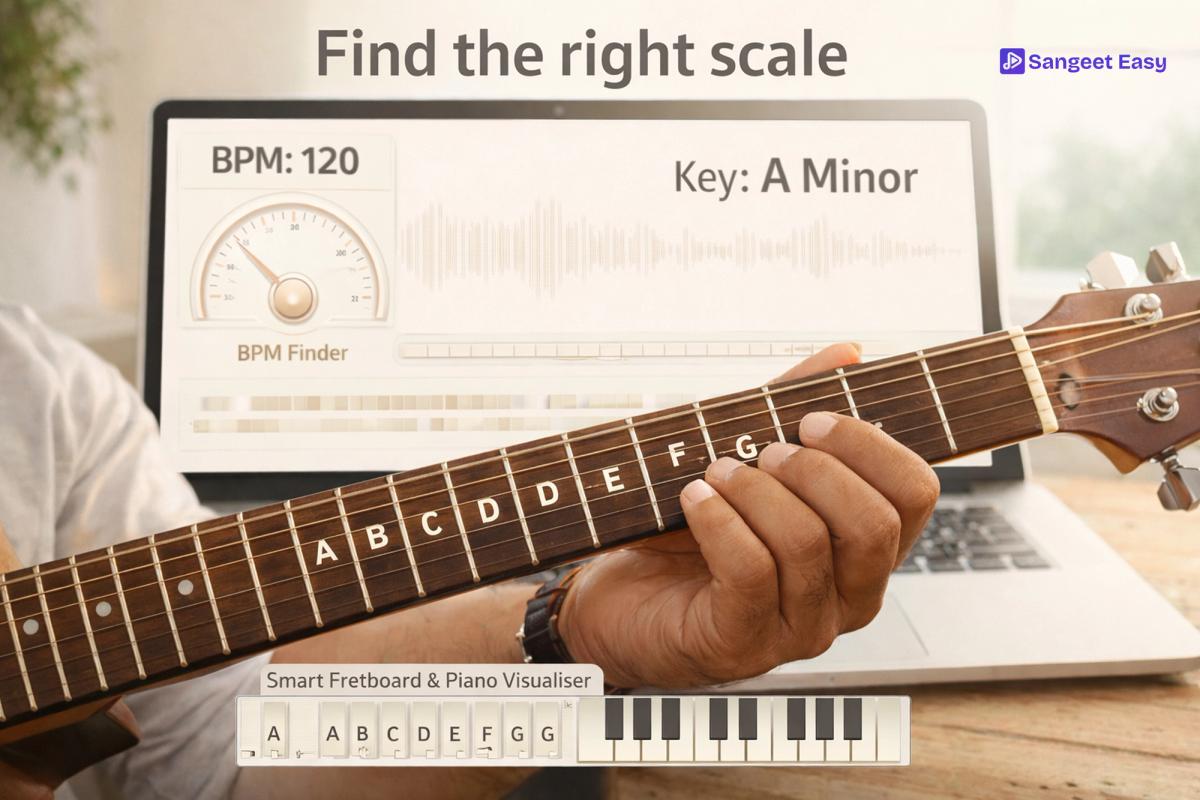
Why guess when AI can tell you in seconds? Sangeet Easy's Key Finder uses advanced audio analysis to detect the exact key and BPM of any song.
Step-by-Step Guide:
- Open the Tool: Go to the Key Finder on Sangeet Easy.
- Upload Your Song: Drag and drop your MP3 or WAV file (e.g., that backing track you downloaded).
- Get Instant Results: Within seconds, the AI will tell you:
- Key: e.g., "C# Minor"
- BPM: e.g., "128 BPM" (Great for setting up your delay pedal!)
- Visualize It:
- Once you know the key (say, C# Minor), go to the Dashboard.
- Open the Smart Fretboard (Theory Visualizer).
- Select C# and Minor Scale.
- Magic: The tool lights up only the notes in that scale on the fretboard. Now you know exactly where to put your fingers for that solo!
Why this is better for Indian Songs?
Indian songs often use "accidentals" (notes outside the standard scale). Sangeet Easy's Pitcher tool can also help you isolate the vocal melody to see exactly which micro-tones (Shrutis) the singer is hitting, helping you distinguish between a standard Minor Scale and a Raga-based scale.
Summary Checklist
- Hum the 'Sa' to find the root note.
- Check the first and last chords.
- Use Sangeet Easy Key Finder for instant confirmation.
- Light up the scale on the Smart Fretboard to start soloing immediately.
Ready to master the fretboard? Launch Sangeet Easy Now and stop guessing!