Discover Your Vocal Range: The Ultimate Guide for Beginner Singers (With Free Tool)
Anil Thakor
Founder of Sangeet Easy

Knowing your vocal range is the secret to sounding like a professional. Whether you aspire to hit the effortless high notes of Shreya Ghoshal and Arijit Singh, or you want to channel the deep, soul-stirring resonance of Jagjit Singh and Usha Uthup, understanding your voice is the first step toward mastery.
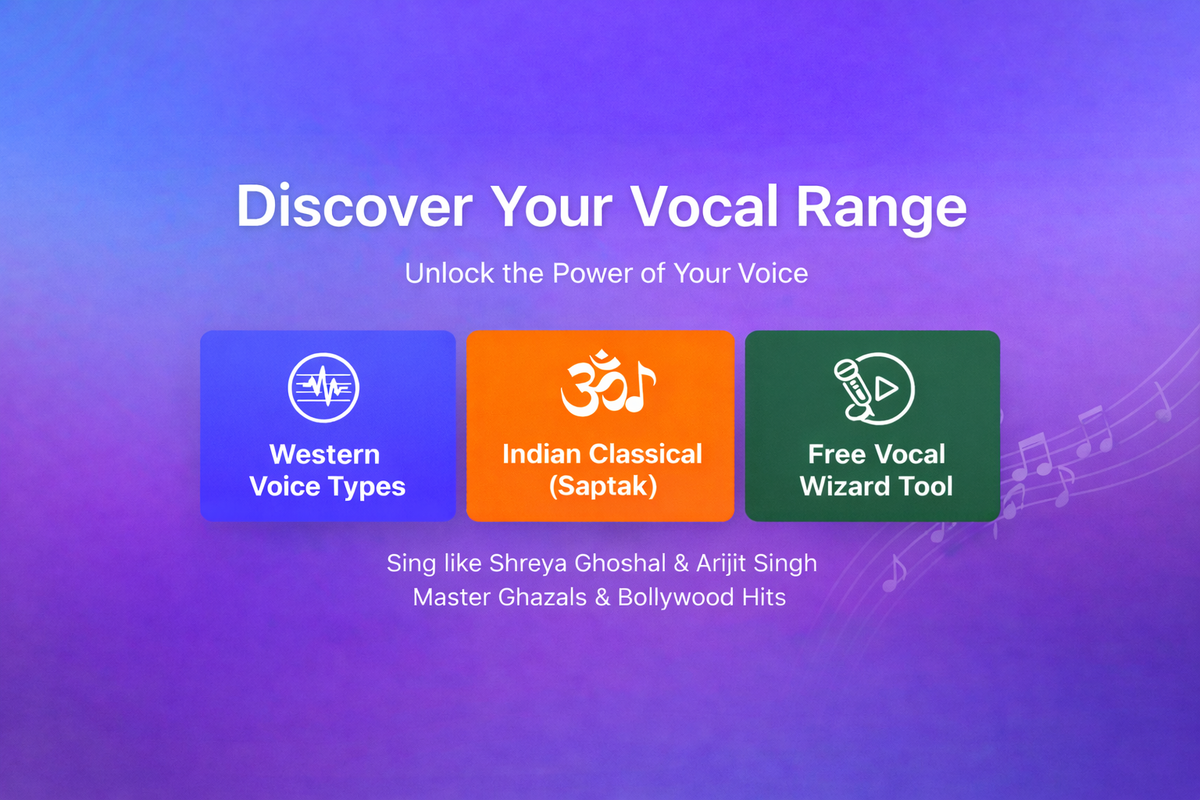
In Indian music, where we often transition between the soulful depths of a Ghazal and the high-pitched energy of a Bollywood hit, knowing your limits helps you pick the right scale (Sa) and prevents vocal strain. In this guide, we’ll explain vocal range through both Western and Indian Classical (Sangeet) lenses and show you how to use the free Vocal Wizard on Sangeet Easy to find yours in minutes.
What is Vocal Range?
Your vocal range is simply the measure of the distance between the lowest note and the highest note that you can sing comfortably. It is usually measured in octaves or specific musical notes (e.g., A2 to C5).
Understanding Voice Types
Voices are typically categorized into types based on range, tone quality, and transition points (passaggio). Here are the common classifications:
Female Voices
- Soprano: The highest female voice type. (Typical range: C4 – C6)
- Mezzo-Soprano: The middle range, common for many pop singers. (Typical range: A3 – A5)
- Alto (Contralto): The lowest female voice type, known for rich, deep tones. (Typical range: F3 – F5)
Male Voices
- Tenor: The highest male chest voice type. (Typical range: C3 – C5)
- Baritone: The most common male voice type, lying between tenor and bass. (Typical range: G2 – G4)

- Bass: The lowest male voice type. (Typical range: E2 – E4)
Indian Classical Voice Types (Saptak)
In Indian classical music (Sangeet), vocal range is often described in terms of "Saptak" (Octaves). A trained singer typically covers about 2.5 to 3 octaves.
- Mandra Saptak (Lower Octave): The lower register, often associated with a deep, chest voice. Notes are usually indicated with a dot below.
- Madhya Saptak (Middle Octave): The normal singing range where most compositions are set.
- Tar Saptak (Higher Octave): The upper register, often produced with a head voice. Notes are indicated with a dot above.
When using the Vocal Wizard, you can see which of these Saptaks you can comfortably traverse in addition to your Western voice type.
How to Find Your Vocal Range in Minutes
You don't need a piano or a professional coach to find your range anymore. Sangeet Easy's Vocal Wizard uses advanced pitch detection to analyze your voice in real-time. Follow these simple steps:
- Open the Tool: Navigate to the Dashboard and click on the Vocal Wizard (or Vocal Range) card.
- Allow Microphone Access: Click the "Start" button. Your browser will ask for microphone permission click "Allow" so the tool can hear you.
- Find Your Lowest Note: Sing the lowest note you can produce comfortably. Sustain it for a prolonged "Ahhh". Watch the pitch meter. When the visualizer is stable (the indicator turns green), click the Lock Low button.
- Find Your Highest Note: Now, sing the highest note you can reach without straining or cracking. Once the specific pitch is stable, click the Lock High button.
- Get Your Results: The tool will instantly calculate your range and tell you your likely Voice Type (e.g., "Baritone" or "Mezzo-Soprano") along with your exact frequency range in Hz.
What's Next?
Once you know your range, you can use other Sangeet Easy tools to improve your singing:
- Pitcher: Change the key of your favorite songs to fit your newfound vocal range.
- Key Finder: Find songs that match your comfortable key.
- Recorder: Practice singing within your range and listen back to improve your tone.
Ready to discover your voice? Try the Vocal Wizard now and start your journey to singing mastery!